




Traditional Craft Meets Modern Performance: HONMAMON “AZUMASYUSAKU” vs. the Silky Nata Outback Edition


Japanese axes and hatchets have earned a strong following because they combine sharp steel, balanced geometry, and simple, effective design. Two tools often compared are the traditional HONMAMON “AZUMASYUSAKU” Round Hatchet and the modern Silky Nata Professional 240 mm Outback Edition.
Many people first heard about the AZUMASYUSAKU when Luke from Outdoor Boys called it his favorite axe. That endorsement opened a lot of eyes to how capable this small Japanese hatchet really is. Unfortunately, these hatchets have become increasingly difficult to source, and consistent supply is now rare.
Because of that, the Silky Nata Outback Edition has become the practical modern choice for anyone who wants a dependable Japanese-style chopping tool today.
HONMAMON “AZUMASYUSAKU” — A Traditional Hatchet with Character
The AZUMASYUSAKU is a hand-forged tool made with Shirogami steel. Its round head shape and light weight—usually between 360 and 500 grams—give it excellent control for limbing, pruning, and splitting small firewood.
Each head is slightly different because every one is shaped by a smith, not a machine. That handmade quality is part of what made the AZUMASYUSAKU so appealing. It feels alive in the hand, and it rewards clean technique. For many people, this was the perfect small bush hatchet.
But with limited availability, it has become more of a collector’s piece than a reliable option you can replace or recommend to others.
Silky Nata 240 mm Outback Edition — A Modern Successor
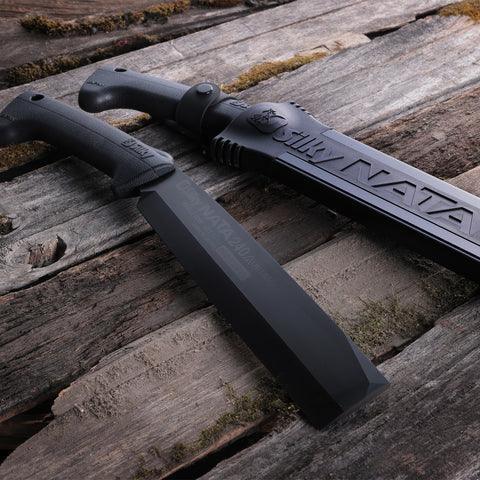
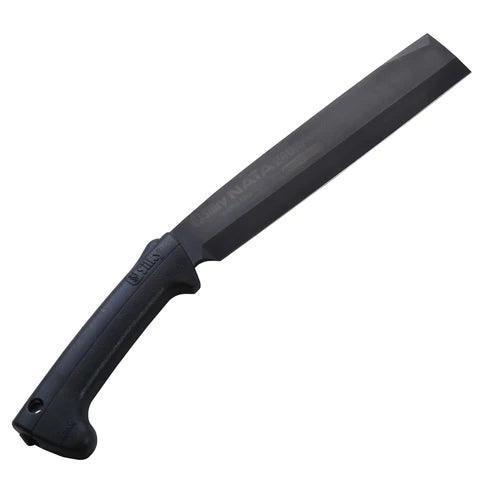
With the AZUMASYUSAKU no longer widely available, the
Silky Nata Professional 240 mm Outback Edition fills the role of a dependable Japanese-style chopping tool.
Product link:
https://axeman.ca/products/silky-nata-professional-240mm-outback-edition-double-edge
The Nata keeps the same basic principles—simple geometry, a double-edge chopping profile, and high-quality steel—but updates them with modern materials built for heavy use. The black-coated blade resists wear and the rubberized handle absorbs shock, making it comfortable for long work sessions.
The 240 mm blade gives more reach and more cutting power than a compact hatchet. It works well for clearing brush, chopping kindling, and general camp work. It also handles the rough Canadian conditions that can be hard on traditional wood-handled tools.
How the Two Tools Compare
Even though they look different, they share important traits:
-
Both follow classic Japanese chopping-tool design
-
Both use a double-bevel cutting edge
-
Both are compact, simple, and effective for everyday camp tasks
-
Both are trusted by outdoorsmen, including Outdoor Boys
Where they differ is in feel and intention:
| Task | AZUMASYUSAKU Hatchet | Silky Nata Outback |
|---|---|---|
| Limbing & light tasks | Precise and nimble | More reach and force |
| Chopping firewood | Best for small pieces | Handles larger chunks |
| Durability | Traditional and delicate | Built to take abuse |
| Availability | Very hard to find | Readily available |
| Grip | Wood handle | Shock-absorbing rubber |
A Realistic Choice Today
If you already own an AZUMASYUSAKU, you know why Luke praised it. It’s an excellent hatchet with a lot of character.
For everyone else, the Silky Nata Outback Edition is the tool you can count on. It keeps the spirit of the Japanese nata alive in a way that is strong, reliable, and easy to source. It is a practical replacement for a traditional tool that has become nearly impossible to get.


Leave a comment (all fields required)